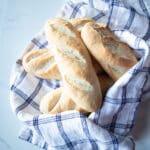
How to Make a Crusty French Baguette
This is a simple bread to make, but be sure to plan your time to allow for an overnight pre-fermentation (the poolish) You'll only need all-purpose flour, water, yeast, and salt to make this classic French baguette bread.
Servings: 6
Calories: 344kcal
Equipment
- Stand mixer fitted with a dough hook
- Large bowl
- baking sheet or a baking stone
- Spray bottle optional
Ingredients
Poolish
- ½ cup water 103˚-110˚F
- ⅛ teaspoon active dry yeast
- 1 cup (4 ½ ounces) all-purpose flour
Bread Dough
- 1 cup + 2 tablespoons water 103˚-110˚F
- 1 ½ teaspoons active dry yeast
- 3 ½ cups (15.75 ounces) all-purpose flour
- 2 teaspoons sea salt
Instructions
Poolish
- Get set up. Weigh your flour if you have kitchen scales. Pour the water in a measuring cup and check the temperature using an instant read thermometer. The water should be 103˚-110˚F. Water warmer than this risks killing the yeast.
- Proof the yeast. Unless I've just purchased the yeast, I recommend testing it before adding the flour. To do this, add the yeast to the water and stir vigorously. Loosely cover the measuring cup and set it in a warm spot of your kitchen. If bubbles form, your yeast is fine.
- Pre-fermentation. Pour the yeast and water into a medium bowl and stir in the flour using a silicone spatula. Cover loosely and set it aside on the counter overnight, or at least 14 hours. It should be bubbly and expanded in volume.Pro-tip: Tightly covering the bowl can suffocate the yeast and kill it.
Bread Dough
- Set up the equipment. Set up a stand mixer if you have one, fitted with a dough hook.
- Make the baguette dough. Add the water (check the temperature for optimal results), yeast, flour, and all of the poolish. Start the stand mixer at a low speed to keep the flour from spraying out of the bowl, and move up the speed as the flour in incorporated. When the ingredients begin to come into a dough, add the salt. Keep the mixer at a medium-low speed (no higher than #3) for 3 - 4 minutes to get a smooth dough that pulls completely away from the sides of the bowl and wraps around the dough hook. It's fine if the dough sticks to the bottom of the bowl.Pro-tip: Waiting to add the salt eliminates the risk of killing the yeast. Yeast should never come into direct contact with raw salt. Once the yeast begins to be incorporated into the water and flour, it's safe to add the salt.
- First two risings. Transfer the dough to a large, lightly oiled bowl and loosely cover with plastic wrap or a tea towel. Set it in a warm place and allow to rise for 45 minutes. It will be expanded and puffy, but not doubled in size.Deflate with your fist, and pull the corners of the dough into the center. Flip it over, loosely cover, and set in a warm place free of drafts. Allow it to rise another 45 minutes. It will be very soft and puffy.
- Divide the dough. Using the kitchen scales (if you want accuracy), weigh the dough and use a bench scraper to divide it into six equal pieces. Form each piece into a ball and cover lightly to rest for 15 minutes.
- Form the dough into baguettes. Taking each piece at a time, while leaving the other balls of dough covered, flatten the ball on a lightly floured work surface using the heel of your hand. Fold the bottom side up as if you were folding a letter up in thirds. But instead of folding the top third over it, pinch the seam and flatten it again with the heel of your hand. Turn the dough 180˚ and repeat by folding the bottom side up as if you're foling a letter in thirds. Pinch the seam and flatten with the heel of your hand.Repeat these 2 steps again. The dough will start to form into a long-ish rectangle.Roll the dough on the counter to an 8" log, slightly tapering the ends to create the iconic baguette shape.
- Third rising. Preheat the oven to 450˚F and place an empty cast iron or oven-safe skillet onto the bottom of the oven to use as a water pan. (Do not use a glass dish.) Remove the upper rack or move it to the top setting and position the lower rack onto the lowest setting slightly above the oven-safe skillet.Line a baking sheet with parchment paper. Drizzle a few drops of olive oil into your palm and lightly coat each baguette with the oil before arranging them with the seam side down on the prepared baking sheet.Lightly cover with plastic and allow to rise for 45-60 minutes. They won't double in size, but will be expanded into pillowy soft baguettes.
- Bake. Remove the plastic and diagonally score each baguette three to five times using a razor blade or very sharp knife. Slide the baguettes into the oven. Add ice cubes and cold water to the hot skillet on the bottom of the oven to create steam and immediately close the oven door. The steam helps create a good crust.Note: If using a baking stone, turn a baking sheet upside down and put the parchment paper over it. Arrange the baguettes on the parchment paper and slide the parchment paper onto the baking stone.Optional: Fill a small spray bottle with water. During the first five minutes of baking, open the oven door and spray the sides of the oven three different times, and immediately close the oven door. This adds steam to the critical first minutes of the baking process which helps to build a crusty exterior.Bake for 20 minutes. Turn the oven off, open the oven door slightly, and leave the bread in the oven for an additional 5 minutes. This also contributes to a nice crust. Remove and cool slightly on a wire rack.
Nutrition
Serving: 1baguette | Calories: 344kcal | Carbohydrates: 71.9g | Protein: 10g | Fat: 1g | Saturated Fat: 0.2g | Polyunsaturated Fat: 0.4g | Monounsaturated Fat: 0.1g | Sodium: 778.4mg | Potassium: 108.5mg | Fiber: 2.8g | Sugar: 0.3g | Vitamin A: 1.9IU | Vitamin C: 0.002mg | Calcium: 15.4mg | Iron: 4.4mg